
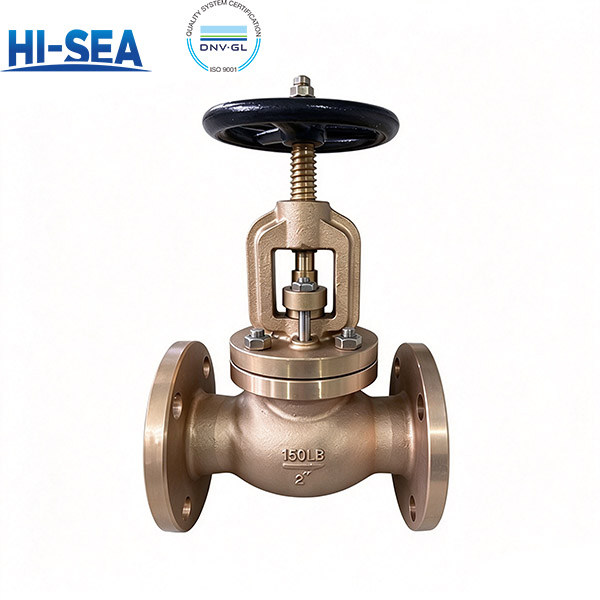
Application
ANSI marine valves are suitable for piping systems on ships, offshore platforms and offshore floating equipment, including ballast water systems, fire-fighting systems, seawater cooling systems, fuel oil / lubricating oil systems, bilge water systems, venting systems and fresh water systems. They are used to connect, cut off and regulate the medium in pipelines, prevent medium backflow, and ensure safe opening and closing of piping systems. The media are generally seawater, fresh water, fuel oil, lubricating oil and compressed air. They are suitable for ocean-going voyages and humid salt-spray corrosive environments, and can meet the inspection and certification requirements of classification societies (ABS, LR, BV, DNV, CCS, etc.).
Main Material
| Main Material | Material Brand | Features | Suitable Medium |
| Bronze | B62 C83600, B148 C95800 | B62 C83600 (Gunmetal/Tin Bronze) has good casting properties and seawater corrosion resistance; B148 C95800 (Nickel-Aluminum Bronze) has high strength and resistance to seawater erosion and corrosion, commonly used for key marine components. |
Seawater, fresh water, fuel oil, lubricating oil, air. C95800 is especially suitable for seawater environments. |
| Cast Steel | WCB, WCC, A105, ZG230-450, | WCB/WCC cast carbon steel has high strength and a wide applicable temperature range (approx. -29°C to +425°C); A105 forged steel is often used for high-pressure small valves; ZG230-450 is a marine cast steel grade used for valve bodies and bonnets. |
Steam, water, oil, gas, petrochemical products. In marine applications, it is also used for seawater, fresh water, lubricating oil, etcétera. (trim material must match). |
| Stainless Steel | CF8, CF8M, CF3, CF3M | CF8 (304) resists general corrosion; CF8M (316) contains molybdenum, resisting chloride pitting, suitable for marine environments; CF3/CF3M are low-carbon versions with stronger intergranular corrosion resistance, suitable for welded structures. |
Water, steam, oil, corrosive media, chemicals. CF8M/CF3M are especially suitable for seawater and offshore environments. |
| Ductile Iron | ASTM A395 | Compared to gray iron, ductile iron has better toughness and is less prone to brittle fracture, while retaining good castability and corrosion resistance. | Water, steam, oil, air, inert gases. In the marine field, it is often used in cost-sensitive and lower-risk systems (e.g., some ballast water and fresh water auxiliary pipelines). |
Standard Systems
ANSI marine valves, i.e., American standard marine valves, follow the American ANSI/ASME B16.34, B16.10, B16.5 / API 609, 6D, 600,602,608,6FA and other American standard systems.
The common pressure ratings are Class 150, 300, and 600.
Class 150: Covers the vast majority of low-pressure marine piping systems (water, oil, gas).
Class 300: Suitable for medium-pressure conditions, such as some steam or high-pressure fuel oil systems.
Class 600: Used for high-pressure pipelines, with bronze being a common materia
Test Pressure Methods (API 598)
1. Shell Test
Medium: Clean water (with rust inhibitor permitted). For austenitic stainless steel valves, the chloride ion content in the water must not exceed 50 ppm.
Test Pressure: 1.5 times the rated cold working pressure (CWP) at 38°C.
Holding Time:
– DN ≤50(NPS ≤2): 15S
– DN 65~150(NPS 2½~6): 60S
– DN 200~300(NPS 8~12): 120S
– DN ≥350(NPS ≥14): 300S
Requirement: No visible leakage or permanent deformation at the valve body, bonnet, and connections.
2. Seat Test
API 598 seat tests are divided into high-pressure and low-pressure tests. The pneumatic tightness test frequently requested by customers for marine bronze valves corresponds to the low-pressure closure test.
High-Pressure Hydrostatic Closure Test: Medium is clean water; pressure is 1.1 times CWP; holding time follows the same rules as the shell test. Metal-seated valves allow extremely minor dripping (based on size and rate), while soft-seated valves require zero leakage.
Low-Pressure Pneumatic Closure Test: Medium is air or inert gas; pressure is 0.4~0.7 bar (approx. 6~10 psi); holding time follows the same rules. Soft-seated valves require zero bubbles, while metal-seated valves allow a small number of bubbles according to the standard.
3. Backseat Test (if the valve is equipped with a backseat feature)
Medium is the same as the shell test; pressure is 1.1 times CWP; with the stuffing box gland loosened, there must be no visible leakage at the stem backseat.
Valve Inspection Introduction (Dimensions, Surface, Painting, Documentation)
(1) Dimension Inspection
Face-to-face dimension: According to ASME B16.10 standard face-to-face dimensions, measured with calipers;
Flange dimensions: Flange outer diameter, bolt hole center circle, number and diameter of bolt holes, flange thickness (B16.5);
Nominal diameter, handwheel dimensions, and connection thread dimensions are all checked against the drawings;
Overall dimensions and installation dimensions must be consistent with customer drawings / classification society drawings.
(2) Surface and Material Inspection
Casting surface: No blowholes, sand holes, cracks, or shrinkage porosity; bronze parts must have a smooth surface, and defects affecting sealing are not allowed;
PMI material testing: Spectrochemical material analysis can be performed as required, with a PMI report issued;
Welds (for welded valves): No slag inclusions or blowholes in welds.
(3) Painting / Anti-corrosion Coating
Carbon steel / ductile iron valve bodies: Sandblasting for rust removal first (Sa2.5 grade), then primer + intermediate paint + topcoat; paint thickness according to marine specifications;
Bronze, stainless steel: Generally not painted, but polished / passivated;
Marking: Cast characters on the valve body must be clear, indicating Class, material, heat number, flow direction arrow, and nameplate information.
(4) Factory Documentation
Factory Certificate of Conformity, Pressure Test Report, Material Certificate, PMI Report, Dimension Inspection Record.